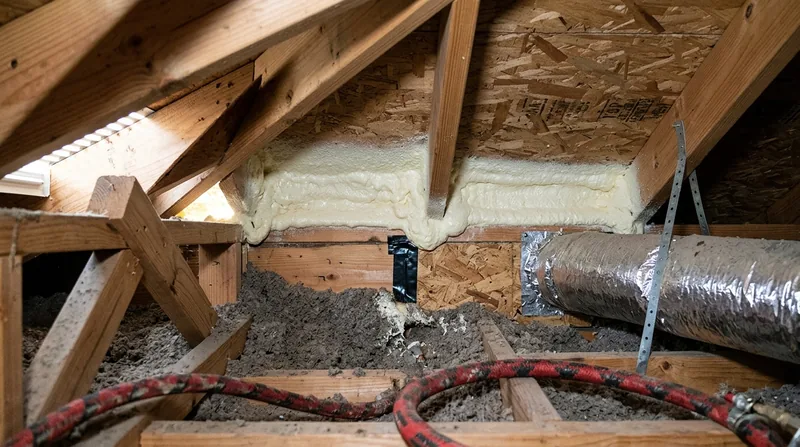




Air sealing in McKinney stops the leak before insulation goes in. McKinney homes sit on the Blackland Prairie north of Dallas, where summer heat climbs past 100 degrees for weeks and nearly every house runs its air handler and ductwork in a vented attic that hits 140 degrees by mid-afternoon. Top plates, can lights, chases, attic hatches, and duct penetrations leak more cooled air than most walls. We seal them before insulating, the step that makes every R-value perform and the cheapest comfort fix in Collin County. A home that bleeds air through unsealed penetrations will never reach its design temperature, no matter how much insulation sits above it. This is not a luxury step. It is the foundation of every retrofit that works.
Why Air Sealing Matters in McKinney's Hot Climate
McKinney's summer heat drives air conditioning costs higher than most of Texas. When your attic hits 140 degrees on a July afternoon, every gap in the top plate, every electrical chase, every unsealed duct penetration becomes a direct path for conditioned air to escape. The Blackland Prairie terrain under slab-on-grade homes means the foundation shifts slightly with seasonal moisture swings, and that movement opens and closes gaps in band joists and rim areas year-round. A 2000s two-story brick home with a vaulted ceiling and west-facing walls bakes all afternoon. Without air sealing, that home is fighting a losing battle against heat gain, and the cooling system runs longer and harder than design intended.
- Sealing top plates before insulation stops conditioned air from leaking directly into the attic cavity.
- Closing penetrations around electrical boxes, plumbing chases, and HVAC ducts prevents air movement between conditioned and unconditioned space.
- Sealed attic hatches and access doors eliminate the single largest leak point in most homes.
- Rim joist and band joist sealing stops thermal bridging and air infiltration in crawl spaces and rim areas.
- Can light and recessed fixture sealing closes gaps that standard fixtures cannot seal on their own.
Air sealing is the precondition of every insulation retrofit. Without it, you are insulating around the leak, not stopping it.
Key info: A 1980s brick two-story in Stonebridge Ranch or Craig Ranch with an upstairs that runs 5 to 8 degrees hotter than downstairs is almost always an air sealing problem first. The attic is not insulated to code, or the top plates and chases are not sealed. Fixing the leak costs less than running the AC harder all summer.
For more detail on how insulation works when air sealing is done correctly, see our attic spray foam insulation page.
How We Seal Air Leaks in McKinney Homes
Air sealing is a precision job, not a spray-and-forget process. We start with a walk-through of the attic to locate every penetration: electrical boxes, plumbing stacks, HVAC ducts, recessed lights, attic hatches, soffit vents that should be closed, and rim areas where the top plate meets the exterior wall. We then seal each point before any insulation is installed. The method depends on the material and the location. Some gaps get closed with closed cell spray foam, others with caulk or gasket materials that are rated for the temperature and the substrate. The goal is airtight, not pretty.
- We inspect the entire attic to identify every air leak, penetration, and unsealed chase.
- We seal top plates where the framing meets the exterior wall using spray foam or backer rod and caulk.
- We close electrical boxes, junction boxes, and recessed light fixtures with foam or gasket materials rated for attic temperature.
- We seal ductwork penetrations and HVAC chases to stop air movement between conditioned and unconditioned space.
- We seal or close soffit vents that are not part of the intended ventilation plan for your roof assembly.
- We install or seal attic hatches with weatherstripping and a rigid frame to eliminate the largest single leak in most homes.
Air sealing is complete before insulation begins. This order matters. A sealed attic with proper insulation will outperform an insulated attic with leaks every single time.
Local example: A 1920s Craftsman bungalow on Tucker Street in historic downtown McKinney has a plank wall and a pier-and-beam floor. The attic has original collar ties, no solid blocking, and electrical chases that run from the basement up through the attic unblocked. Air sealing that home means closing the chases at the top plate and sealing every electrical penetration. The cost is modest. The comfort gain is immediate.
For details on the insulation that follows sealing, see our open cell spray foam page for attic comfort jobs and closed cell spray foam page for maximum R-value in vented attics.
Air Sealing Methods and Materials
| Method | Application | Best for |
|---|---|---|
| Closed cell spray foam | 1 to 2 inch seal around large penetrations, top plates, rim joists, and band joists. | Air sealing before attic insulation; moisture control in crawl spaces and rim areas. |
| Caulk and backer rod | Sealing small gaps, electrical boxes, and chase walls where foam would be overkill. | Electrical penetrations, small cracks in framing, soffit vent closure. |
| Gasket materials and weatherstripping | Sealing attic hatches, access doors, and removable panels to create an airtight seal. | Attic hatch sealing, removable access covers, recessed light fixtures. |
| Rigid blocking and foam | Closing open chases and large voids by blocking with rigid material and sealing edges. | Plumbing stacks, electrical chases, HVAC ducts that run through attic without solid blocking. |
The choice of method depends on the gap size, the material it contacts, the temperature range, and whether the area will be accessible after sealing. Spray foam works for large penetrations and rim areas. Caulk works for small gaps. Weatherstripping works for hatches and doors. We use the right tool for each job.
Air Sealing Cost in McKinney: What to Expect
Air sealing costs depend on the size of the attic, the number of penetrations, the complexity of the layout, and the method required. A modest 1,500 square foot ranch with a straightforward attic and fewer than a dozen major penetrations will cost less than a 3,500 square foot two-story with vaulted ceilings, multiple chases, and a complex roof line. Access also matters. An attic with full flooring and clear walkways is faster than one where crew must navigate trusses and insulation. Most air sealing jobs in McKinney start at $650 to $1,200 for a single-story home and can run higher for two-story or complex layouts.
The best approach is to get a free written estimate. We will walk your attic, count the penetrations, assess the access, and give you a firm number before any work begins. Most homeowners find that air sealing is the cheapest comfort upgrade they can make. For detailed pricing on air sealing as part of a larger insulation retrofit, see our pricing page.
Air Sealing Near Me: What McKinney Homeowners Should Know Before Hiring
Air sealing is a small-ticket job, which means it attracts both honest local crews and fly-by operators who bundle it into a larger spray foam estimate without detail or inspection. Before you hire anyone, ask for a written estimate that lists every penetration that will be sealed, the method for each, and the material. A good estimate will specify the square footage of attic, the number of electrical boxes, the number of can lights, the attic hatch condition, and the rim or band joist area if applicable. Ask for references from recent jobs in McKinney, Plano, Frisco, or nearby areas. Confirm that the contractor is fully insured and ask to see the certificate. Ask about the timeline. A typical air sealing job takes one to two days, depending on size.
If your home is in a master-planned community like Stonebridge Ranch, Craig Ranch, Tucker Hill, or Trinity Falls, check your HOA rules before work begins. Most HOAs do not govern insulation work inside the attic, but exterior work on metal buildings or pole barns in those areas may require architectural approval. If you have questions about permits or regulations specific to your city or neighborhood, we can help you navigate what applies to your address. Call us at (469) 247-0288 for a free estimate, or contact us online and we will respond within 24 hours.
Air Sealing in McKinney: Pricing Guide
| Service | Price | Details |
|---|---|---|
| Single-story ranch air sealing | Starting at $650 | Top plates, electrical boxes, attic hatch, soffit vents, fewer than 10 major penetrations, straightforward layout |
| Two-story home with vaulted ceilings | Starting at $1,200 | Multiple chases, recessed lights, complex roof line, higher attic volume, more penetrations to seal |
| Air sealing plus open cell or closed cell spray foam | On estimate | Combined air sealing and insulation job; cost depends on attic size, R-value target, and insulation type selected |
| Travel to McKinney and surrounding areas | Included | No separate mileage fee or travel charge within McKinney, Plano, Frisco, Allen, Prosper, and nearby cities |
| Free written estimate | No charge | Response within 24 hours, attic walk-through, written scope and price, no obligation to book, call (469) 247-0288 |
Indicative pricing, the exact cost depends on square footage, finish, and site access. Free personalized estimate within 24h at (469) 247-0288.


