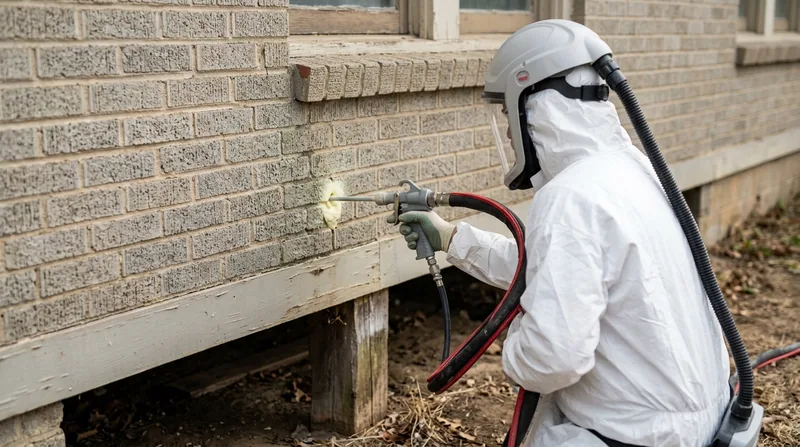




Wall & Injection Foam Insulation in McKinney fills the empty cavities behind brick veneer and inside frame walls without cutting into drywall or tearing out finishes. McKinney's housing stock spans from 1880s Victorians on the downtown square to 1960s-80s brick ranches scattered across the east side and newer two-story homes in Stonebridge Ranch and Craig Ranch, and nearly every one of those older homes carries uninsulated or poorly insulated walls that bleed heat in winter and let the Texas sun cook the interior in summer. Injection foam is the retrofit answer for homes where the walls are empty but the exterior is sound, the foundation is stable, and the homeowner wants insulation without demolition. We drill small ports through the brick or siding, pump closed-cell foam into the cavity, and patch the ports to match. No dust, no mess inside the home, and the walls stay intact.
Why Wall & Injection Foam Insulation Matters in McKinney's Older Neighborhoods
McKinney's historic districts and mid-century ranches were built when energy costs were low and insulation standards were minimal. Many of those homes have brick veneer over a wood-frame wall with nothing but air in the cavity between the brick and the interior finish. In summer, when afternoon temperatures climb past 95 degrees and west-facing walls bake in direct sun for six hours, that air gap becomes a heat superhighway. In winter, when the temperature drops below freezing, the same cavity loses warmth to the outside. Injection foam seals that cavity, cuts the heat transfer, and stabilizes the interior temperature without requiring any exterior or interior demolition.
- Fills empty cavities behind brick veneer in 1960s-80s ranches across McKinney, Plano, and Frisco without removing brick or drywall.
- Adds thermal resistance to frame walls in historic Victorians and Craftsman bungalows on Chestnut, Church, and Tucker streets downtown.
- Reduces heat gain on west-facing walls that absorb afternoon sun during McKinney's 100-degree summer weeks.
- Seals air leaks within the wall cavity, stopping drafts and moisture infiltration in one application.
- Leaves no visible trace once the small drilled ports are patched and painted to match the exterior.
Getting your walls insulated correctly the first time means choosing a contractor who understands the difference between injection foam and spray foam, knows which walls are candidates, and can patch ports so they disappear into the exterior finish.
Key info: McKinney's 1960s-80s ranches typically have cavities 3.5 to 5.5 inches wide between the brick veneer and the wood frame. Those cavities are often empty or contain only air. Injection foam fills that space completely and adds R-value between 3.6 and 6.5 per inch depending on the product. A typical 1,500-square-foot ranch with 40 percent of its wall area in cavities can gain 5 to 8 R-value points in those walls, which translates to measurable reduction in heating and cooling load. For more context on how different foam types perform, see our guide to closed-cell spray foam insulation.
Before you hire any contractor, confirm that your city requires contractor registration for insulation work. The City of McKinney, the City of Plano, and the City of Frisco each have their own requirements. Ask any contractor for proof of registration with your city before work begins, and verify it directly with the city's permit or development services office. You can also review McKinney's building permit and contractor information on the city website.
How We Perform Wall & Injection Foam Insulation in McKinney
Injection foam insulation is a methodical process that begins with a detailed inspection of the walls you want to insulate. We identify the cavity depth, check for obstructions like fire blocking or old insulation, and determine the best port locations to ensure complete fill. The work is quiet, contained, and requires no interior disturbance. We drill small holes through the exterior veneer or siding, insert the injection ports, pump the foam into the cavity under controlled pressure, and then remove the ports and patch the holes with color-matched caulk or sealant. The entire process takes one to three days depending on the square footage of wall to be filled.
- We inspect the wall cavity using a borescope or by drilling a test port to confirm the cavity is empty and free of obstructions.
- We mark port locations on the exterior, spacing them 16 to 24 inches apart vertically and horizontally to ensure complete coverage.
- We drill 1-inch holes through brick, siding, or stucco and install injection ports into the cavity opening.
- We pump closed-cell foam into the cavity at the correct pressure and temperature, filling from the bottom up to avoid air pockets.
- We remove the ports and patch each hole with exterior caulk, paint, or mortar to match the surrounding finish.
- We verify density and fill by weight and visual inspection, and we document the R-value and thickness on your estimate and invoice.
The result is a fully insulated wall cavity with no interior disruption and no visible trace of the work from the street.
Example: A 1970s brick ranch in Allen with a 1,200-square-foot west-facing elevation and 40 percent wall cavity coverage (480 square feet of cavity) receives injection foam at 2 pounds per cubic foot density. The cavity is 4 inches deep, so 480 square feet times 4 inches equals 64 cubic feet. At 2 pounds per cubic foot, the foam weighs 128 pounds. The job takes one day, includes 24 ports, and costs between $960 and $1,200 depending on foam type and access. The homeowner patches the ports with exterior caulk to match the mortar, and the work is invisible from the street within 48 hours. See our full pricing overview for more examples and cost drivers.
| Approach | Description | Best For |
|---|---|---|
| Closed-Cell Injection Foam | 2-pound closed-cell polyurethane injected into wall cavities, fills completely, cures in 24 hours, R-value 6.0 to 6.5 per inch. | Empty brick veneer cavities in ranches, frame walls in older homes, any wall where vapor barrier and moisture resistance matter. |
| Open-Cell Injection Foam | 0.5-pound open-cell polyurethane injected into cavities, less expensive, R-value 3.5 to 3.8 per inch, allows vapor diffusion. | Budget retrofit of interior walls or non-climate-critical cavities where vapor permeability is acceptable. |
| Partial Cavity Fill | Foam injected to a set thickness rather than complete fill, reducing material cost and curing time. | Cavities where complete fill is not needed, or where cost sensitivity requires a middle-ground solution. |
| Retrofit with Existing Insulation Removal | Old fiberglass or cellulose removed first, cavity cleaned, then injection foam applied to ensure complete contact and no voids. | Walls with failed, settled, or water-damaged insulation that must be cleared before new foam can be effective. |
Wall & Injection Foam Insulation Cost in McKinney: What to Expect
Wall and injection foam insulation typically runs from $2 to $3.50 per square foot of wall cavity, depending on cavity depth, foam type, port density, and patch material. A 1,500-square-foot ranch with 40 percent cavity coverage (600 square feet of actual cavity) and 4-inch-deep walls costs between $1,200 and $2,100 for closed-cell foam with patch work. Open-cell foam runs 20 to 30 percent less. The price moves based on how many ports are needed (wider cavities and deeper walls require more ports), whether old insulation must be removed first, the difficulty of patching (matching historic mortar costs more than caulk on modern siding), and travel time if the job is far from our McKinney shop.
Several factors affect the final cost. Cavity width and depth determine how much foam you need and how many ports are required. Exterior finish (brick, stucco, wood siding, or fiber cement) affects patching time and material cost. Presence of old insulation, moisture, or obstructions in the cavity adds removal or remediation work. Accessibility of walls from the ground versus requiring scaffolding or a lift changes labor time. The best way to get an accurate price is to request a free estimate and have us inspect the walls in person. We measure cavity depth, count the linear feet of wall to be filled, and give you a written estimate with R-value, thickness, and total cost before any work begins.
For more detailed pricing examples across different job sizes and foam types, see our complete pricing page.
What to Look for When Hiring a Spray Foam Contractor Near McKinney
Choosing the right contractor for wall and injection foam insulation is about verification, not reputation alone. You want a contractor who understands the difference between injection foam and spray foam, can explain why one method is right for your walls, and will give you a written estimate with specific R-values and thicknesses before starting work. Many contractors in the spray foam trade are rig-and-run operations from out of state, spraying a job in an afternoon and disappearing before the smell fades. Others are national franchises with high overhead and higher prices. A local contractor with a McKinney address and local plates is easier to reach if questions arise after the work is done.
- Ask the contractor for proof of current liability insurance and request a certificate of insurance before work begins.
- Verify that the contractor is registered with your city if your city requires contractor registration (McKinney, Plano, Frisco, and others do).
- Request a written estimate that includes R-value per inch, total thickness, square footage of cavity to be filled, and the total price.
- Ask for references from homeowners in McKinney or nearby areas and call at least two to ask about the quality of work and whether the contractor was responsive after the job.
- Confirm that the contractor will not spray over wet, contaminated, or leaking walls, and will walk away if the substrate is not suitable.
- Ask about the re-entry window after the foam cures and whether any ventilation or safety precautions are needed during that period.
A contractor who rushes you into a decision, quotes a price without an on-site inspection, promises immediate re-entry, or cannot provide proof of insurance is a red flag. Take your time, get two or three estimates, and choose the contractor who takes the most care explaining the work and the most time inspecting your home.
Ready to move forward? Contact us for a free estimate. We respond within 24 hours at (469) 247-0288.
Wall & Injection Foam Insulation in McKinney: Pricing Guide
| Service | Price | Details |
|---|---|---|
| Closed-Cell Injection Foam, Standard Cavity | Starting at $2.50/sq ft | Complete fill of 3.5 to 5.5-inch cavities in brick veneer or frame walls, R-value 6.0 per inch, all ports patched |
| Open-Cell Injection Foam, Budget Retrofit | Starting at $1.75/sq ft | Lower-cost alternative for interior or non-critical walls, R-value 3.6 per inch, fewer ports required, same patch finish |
| Cavity Fill with Existing Insulation Removal | Starting at $3.00/sq ft | Old fiberglass or cellulose removed first, cavity cleaned and inspected, then foam injected, adds labor and disposal cost |
| Patch Material and Finish | Included | Standard exterior caulk for siding, mortar matching for brick, historic color matching available at no additional charge |
| Travel and Site Visit | Included | Free estimate within McKinney, Plano, Frisco, Allen, Prosper, and surrounding service areas, response within 24 hours |
| Complex or Multi-Story Retrofit | On estimate | Large homes, historic buildings, or jobs requiring scaffolding or special equipment need on-site assessment before final pricing |
Indicative pricing, the exact cost depends on square footage, finish, and site access. Free personalized estimate within 24h at (469) 247-0288.


