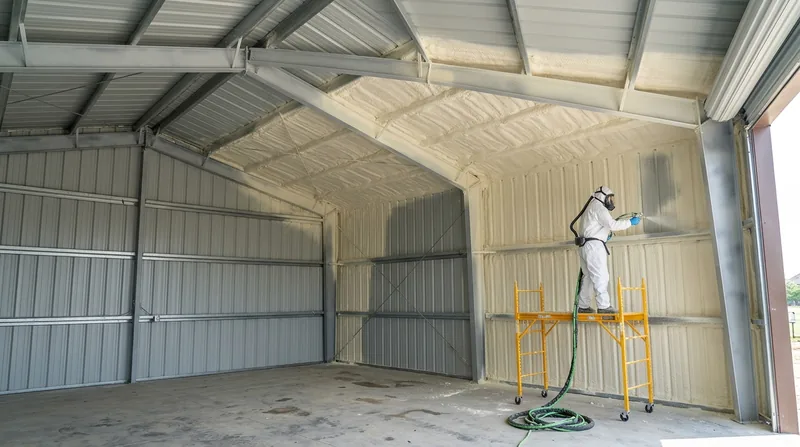




Metal Building & Barndominium Spray Foam in McKinney solves the single biggest problem that keeps steel structures from being livable: condensation. From the horse barns and ag shops around Princeton and Farmersville to the steel-frame homes and pole structures spreading across Stonebridge Ranch and the acreage tracts north toward Celina and Melissa, metal buildings in the McKinney area face brutal summer heat and sharp temperature swings that turn uninsulated steel into a sweating box. Closed-cell spray foam stops that moisture cold, seals every air leak at once, and delivers the R-value per inch that fiberglass cannot match in a metal-frame space. We have been installing spray foam in metal buildings, barndominiums, and commercial shells across Greater McKinney since 2012, and we know exactly why this work matters in a region where summers push past 100 degrees for weeks and winter mornings drop fast enough to pull condensation from the air.
Why Condensation Control Matters in McKinney Metal Buildings
Metal conducts heat and cold with no resistance. A steel roof or wall frame in a McKinney summer afternoon can hit 140 degrees on the outside while the interior air, cooled by a window unit or portable AC, drops to 75 degrees. That temperature difference pulls moisture from the air and deposits it on every cold surface inside, rusting fasteners, rotting wood blocking, and breeding mold on stored items. Fiberglass batts and blown-in cellulose do not stop this problem because air moves freely through them, and air carries moisture. Closed-cell spray foam seals the building envelope tight, stops air infiltration completely, and its vapor-impermeable skin prevents moisture from ever reaching the steel frame underneath.
- Closed-cell foam creates an air-tight seal that stops warm, humid air from reaching cold metal surfaces and sweating.
- The foam's vapor barrier blocks moisture migration, protecting steel fasteners and wooden structural members from rust and rot.
- A sealed metal building holds interior temperature more evenly, reducing the temperature shock that triggers condensation in the first place.
- Spray foam fills every cavity, seam, and penetration in a single pass, whereas batts and rolls leave gaps that air exploits.
This is why closed-cell foam is the standard for metal buildings, barndominiums, and pole structures across the region.
Local example: A barndominium outside Celina with a steel frame and vaulted ceiling was sweating so badly on cool mornings that the owner was wiping condensation off the inside of the roof panels. After we sealed the entire structure with 2 inches of closed-cell foam, the interior humidity stabilized, and the sweating stopped completely. The building now holds temperature, and the owner can store tools and equipment without worry.
For official guidance on building code requirements for your specific metal building or barndominium, contact your local building department. In McKinney, that is the City of McKinney Development Services office, which governs energy code compliance and thermal barrier requirements for foam insulation in all structures.
How We Insulate Metal Buildings and Barndominiums in McKinney
The work starts with a walk-through to understand the structure, the use, and the moisture problem you are trying to solve. We assess the existing condition of the metal frame, check for any active leaks or rust, and determine whether the substrate is dry and ready for foam. If there is standing water, active leaks, or rust that needs treatment first, we tell you straight and we do not spray until that is fixed. Once the structure is dry and ready, we lay out the job: thickness, R-value, and the number of passes required to reach your target insulation level.
- We inspect the metal frame, roof panels, and walls for moisture, rust, or damage that must be addressed before foam is applied.
- We set up mechanical ventilation and establish a re-entry window, typically 24 to 48 hours, during which the building should remain closed and unoccupied.
- We spray closed-cell foam in controlled passes, maintaining proper drum temperature and manufacturer ratio to ensure full expansion and adhesion.
- We document the R-value and thickness in writing so you have a clear record of what was installed and where.
- We clean up debris, remove temporary ventilation, and walk you through post-cure care and any touch-up work needed.
The entire process is built around getting the foam right the first time and leaving you with a sealed, insulated structure that stays dry and comfortable.
Typical project: A 40-by-60-foot pole barn near Princeton used for equipment storage and light metalworking was losing temperature in winter and sweating in summer. We sealed the entire structure with 3 inches of closed-cell foam on the roof and 2 inches on the walls, creating a fully insulated envelope. The job took three days of prep, spray, and cure, and the building now holds temperature and stays dry year-round. The owner reports that tools no longer rust overnight and the space is usable in all seasons.
For more detail on how spray foam is applied and what happens during the cure window, see our Closed Cell Spray Foam page, which covers the science and the technique in depth.
Metal Building Insulation Methods and Approaches
| Approach | Description | Best for |
|---|---|---|
| Closed-Cell Spray Foam, 2-3 inches | High-density foam that stops air and moisture completely, R-value 6-7 per inch, vapor barrier included. | Metal buildings, barndominiums, pole barns, and any structure where condensation control is the priority. |
| Closed-Cell Spray Foam, 4-6 inches | Thicker application for maximum R-value and thermal mass, used in climate-controlled spaces like barndominiums with living quarters. | Residential barndominiums, workshops with HVAC, and commercial metal buildings in high-temperature environments. |
| Hybrid: Closed-Cell Base + Open-Cell Top | Closed-cell foam applied to all metal surfaces for vapor control, then open-cell foam sprayed for sound dampening and cost savings in non-climate-controlled spaces. | Large agricultural buildings, RV garages, and metal shops where condensation control is critical but full R-value is secondary. |
| Foam Plus Air Sealing | Spray foam on all walls and roof, plus mechanical air sealing around doors, vents, and penetrations to eliminate any remaining air leaks. | Sealed barndominiums, climate-controlled metal buildings, and structures where energy efficiency is a priority. |
Metal Building & Barndominium Spray Foam Cost in McKinney: What to Expect
The cost of spray foam for a metal building or barndominium depends on the size of the structure, the thickness of foam you need, and how much of the building gets sprayed. A small 30-by-40-foot pole barn might run $2,000 to $4,000 for 2 inches of closed-cell foam on the roof and walls. A larger barndominium with 2,000 square feet of insulated space could run $6,000 to $12,000 or more depending on height, access, and whether the entire structure or just portions are being sealed. Starting at around $1.75 per square foot is a realistic baseline for closed-cell foam in a metal building, but that number moves up if the building is tall, hard to access, or requires scaffolding or lifts.
The best way to understand your actual cost is to get a written estimate that specifies the R-value, the thickness in inches, the square footage being treated, and the total price. We provide free, written estimates with all of those details spelled out so there are no surprises when the work starts. We also explain what factors move the price up or down: a 60-foot-tall metal building costs more per square foot than a 20-foot one because we need lifts or scaffolding. A building with a complex roof geometry costs more than a simple rectangular barn. A structure with poor access costs more than one sitting in an open lot.
For a detailed breakdown of pricing across all our services and to see how metal building work compares to other spray foam jobs, visit our full pricing page.
What to Look for When Hiring a Spray Foam Contractor Near McKinney
The spray foam market in McKinney and across North Texas includes everything from local, long-term shops to out-of-state crews that show up, spray, and disappear. The difference shows up after the job is done. A good spray foam contractor, including us, gives you a written estimate with R-value and thickness, explains the re-entry window and why it matters, provides proof of insurance, and stays reachable if questions come up weeks or months later. A bad one quotes a price with no details, promises immediate re-entry, and vanishes when the smell will not go away or the foam does not cure right.
- Ask any contractor for proof of insurance and verify it covers spray foam work; do not accept a verbal promise or a photocopy you cannot verify.
- Request a written estimate that lists the R-value, thickness in inches, square footage, and the total price, not a vague range or a price per board foot with no scope.
- Confirm that the contractor understands your local building code and knows what thermal barrier and ignition barrier requirements apply at your address.
- Ask about the cure window and re-entry timeline; any contractor promising you can re-enter the building in a few hours is not following manufacturer guidance and is a red flag.
- Check references from jobs in McKinney, Plano, Frisco, or nearby towns; talk to at least two past customers about their experience and whether the work held up.
When you are ready to move forward, contact us for a free estimate at (469) 247-0288. We will inspect your metal building or barndominium, explain what closed-cell foam will do for your condensation problem, and give you a clear price with no pressure to book.
Metal Building & Barndominium Spray Foam in McKinney: Pricing Guide
| Service | Price | Details |
|---|---|---|
| Metal Building or Pole Barn, 2 inches closed-cell | Starting at $1.75/sq ft | Covers roof and walls for condensation control; cost rises with building height and complexity of roof geometry |
| Barndominium or Climate-Controlled Space, 3-4 inches closed-cell | Starting at $2.25/sq ft | Higher R-value for residential comfort and HVAC efficiency; access, vaulted ceilings, and interior finishes affect final price |
| Large Metal Building or Complex Structure | On estimate | Height over 40 feet, difficult access, multiple roof angles, or hybrid foam approach requires site inspection for accurate pricing |
| Travel | Included | No mileage fee or travel surcharge within McKinney and surrounding service areas across Collin County |
| Written Estimate | Free | Includes R-value, thickness, square footage, and detailed scope; response within 24 hours at (469) 247-0288 |
Indicative pricing, the exact cost depends on square footage, finish, and site access. Free personalized estimate within 24h at (469) 247-0288.


