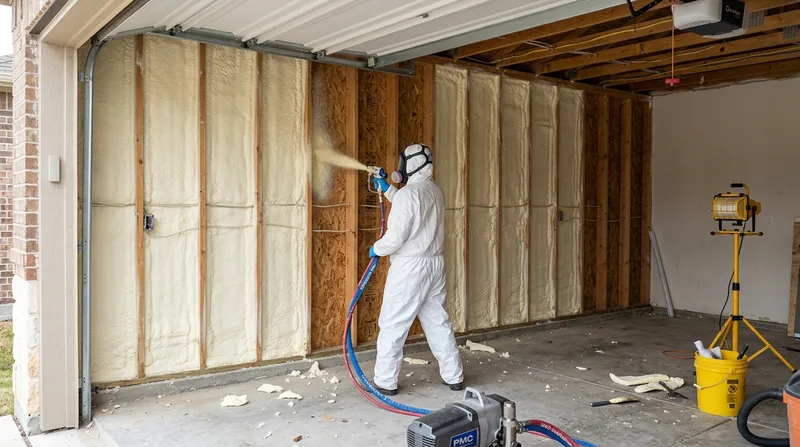




McKinney's newer subdivisions like Stonebridge Ranch, Craig Ranch and Trinity Falls are packed with two-story homes featuring steep composition roofs, vaulted ceilings, and bonus rooms built directly over three-car garages. Those garages sit directly below living space, with only a thin ceiling and shared wall between conditioned air and radiant afternoon heat that bakes the slab and framing all summer. A garage ceiling under a bonus room with no insulation or air sealing becomes a thermal sieve, dumping heat through the floor above and turning the bonus room into an unusable oven by 2 p.m. Garage spray foam insulation in McKinney seals that ceiling and the walls shared with the house, blocking the radiant load before it enters the living space. The difference is immediate: a usable room instead of a storage oven, and lower cooling bills for the whole house. We have been insulating garages and bonus rooms across McKinney, Plano, Frisco and Allen since 2012, and we handle the work the same way we handle every job: controlled thickness, the right foam type for the application, proper ventilation during cure, and a written estimate with R-value and thickness specs so you know exactly what you are getting.
Why Garage Insulation Matters in McKinney's Hot Climate
McKinney sits on the Blackland Prairie north of Dallas, where summer temperatures routinely exceed 100 degrees for weeks at a time. A garage ceiling under a bonus room acts as a heat bridge between the exterior and the conditioned space above. Without insulation and air sealing, that ceiling radiates absorbed heat directly into the room overhead, forcing the AC to work harder and longer. The problem is worse on the west side of the garage, where afternoon sun bakes the roof and framing for hours. Spray foam seals both the ceiling and the rim where the garage wall meets the house structure, stopping radiant and convective heat before it enters the living space.
- Spray foam blocks radiant heat from baking the ceiling and walls shared with the house.
- Air sealing eliminates convection pathways that let hot air move from the garage into bonus rooms and upper bedrooms.
- A properly insulated garage ceiling reduces the cooling load on the whole-house AC system.
- Closed cell foam provides the R-value density needed in tight spaces and resists moisture from seasonal humidity swings.
- Open cell foam is a lower-cost option for garage ceilings in dry climates and offers better sound dampening if the garage is used as a workshop.
The payoff is a bonus room that is actually usable in July and August, and energy savings that show up on every cooling bill from May through September.
McKinney Example: A 400-square-foot bonus room over a three-car garage in Stonebridge Ranch, with no ceiling insulation and a west-facing roof, ran 78 degrees in the upstairs bedrooms while the downstairs held 72. After garage ceiling foam and air sealing, the bonus room held 74 degrees with the same thermostat setting and the owner cut 45 minutes off the AC runtime every afternoon. That translates to measurable savings from June through September.
How We Insulate Garage Ceilings and Walls in McKinney
Garage spray foam insulation requires precision and planning. The ceiling must be clean and dry, the foam applied at the correct thickness in controlled passes, and the space ventilated during cure. We work from the inside, spraying the underside of the roof deck and the interior faces of the rim joist and band joist where the garage wall meets the house. For bonus rooms, we also seal the top of the shared wall to stop heat transfer through the framing. The entire process takes one to two days depending on the size of the garage and the complexity of the ceiling framing.
- We inspect the garage ceiling and walls for existing insulation, moisture, or damage before quoting.
- We remove any loose fill or fiberglass insulation that blocks access or compromises the foam bond.
- We apply closed cell or open cell spray foam at the specified thickness and R-value, measured in board feet on site.
- We seal all rim joists, band joists, and the perimeter where the garage wall meets the house frame.
- We set up mechanical ventilation during cure and establish a re-entry window so you know when the space is safe to use.
- We provide a written estimate with R-value, thickness, and board footage so you have a clear record of what was installed.
The result is a garage ceiling that stops heat before it enters the bonus room, and a house that cools more efficiently all summer long. For more detail on how closed cell and open cell foams differ and which is right for your garage, see our closed cell spray foam page and open cell spray foam page.
Local Example: A three-car garage in Allen with a bonus room over two bays, vaulted ceiling, and no existing insulation. We sprayed 3.5 inches of closed cell foam on the ceiling (R-21) and sealed the rim joist and shared wall. The job took one day, cost from $2,100, and the homeowner reported that the upstairs bedroom temperature dropped 5 degrees and stayed stable through the afternoon. The garage itself became usable for a workshop without the heat radiating into the room above.
| Approach | Description | Best For |
|---|---|---|
| Closed Cell Spray Foam | High-density foam with an R-value of 6 to 7 per inch. Resists moisture and provides structural strength. Thinner application achieves higher R-value in tight spaces. | Bonus rooms, shared walls with the house, garages in humid climates, and anywhere space is limited and moisture control matters. |
| Open Cell Spray Foam | Lower-density foam with an R-value of 3.5 to 4 per inch. Lighter, more flexible, and better at sound dampening. Requires more thickness to reach the same R-value as closed cell. | Workshop garages where sound control is a priority, dry climates, and budgets that favor lower cost per board foot over density and moisture resistance. |
| Ceiling-Only Spray Foam | Foam applied only to the underside of the roof deck and the rim joist. Does not include the full wall treatment. Reduces radiant heat but leaves some air leakage paths open. | Budget-conscious jobs where the primary goal is blocking radiant heat from a bonus room, and where air sealing the shared wall is handled separately. |
| Full Garage Enclosure | Ceiling, rim joist, band joist, and all interior walls of the garage sprayed with foam. Provides complete thermal and air sealing. Turns the garage into a conditioned or semi-conditioned space. | Workshop conversions, garage studios, and homes where the garage will be heated or cooled as part of the living space. |
Garage Spray Foam Insulation Cost in McKinney: What to Expect
Garage spray foam insulation in McKinney starts at $1,200 for a single-car garage ceiling with basic rim joist sealing. A two-car or three-car garage with a bonus room overhead, full wall sealing, and closed cell foam typically runs $1,800 to $3,200 depending on the size of the ceiling, the R-value specified, and the complexity of the framing. The biggest factors that move the price are the square footage of the ceiling, the foam type (closed cell costs more but delivers higher R-value in less thickness), the height and accessibility of the ceiling, and whether existing insulation needs to be removed first. A detailed written estimate with R-value and board footage gives you a clear picture of what the job costs and why. Visit our pricing page for a full breakdown of garage insulation options and what drives the cost up or down.
Getting two or three estimates from different contractors is smart. Each estimate should include the R-value you are paying for, the thickness of the foam, the total board footage, the foam type (closed or open cell), and the re-entry and cure time. Estimates that skip R-value and thickness specs, or that quote a price per square foot without measuring the ceiling, are red flags. The lowest price is rarely the best deal if it comes with no detail and no warranty on the workmanship.
Garage Spray Foam Insulation Near Me: What McKinney Homeowners Should Know Before Hiring
Choosing a spray foam insulation contractor is a decision that affects your comfort and your energy bills for years to come. The best contractors are fully insured, provide written estimates with R-value and thickness specs, explain the cure and re-entry timeline upfront, and are reachable if questions come up after the job. McKinney homeowners should also confirm that any contractor they hire understands local building codes and can help navigate permitting if it applies to their address. Permits and contractor registration requirements vary from city to city across Greater McKinney, so always ask your contractor whether a permit is required at your address and confirm it with your local building department before work begins.
- Verify that the contractor is fully insured and can provide a certificate of insurance on request.
- Ask for written estimates from at least two contractors, and compare R-value, thickness, foam type, and board footage, not just the total price.
- Request references from recent garage insulation jobs in McKinney, Plano, Frisco or Allen, and follow up with at least one homeowner.
- Confirm that the contractor understands local building codes and can help you determine whether a permit is required for your job.
- Ask about the cure and re-entry timeline, and whether the contractor provides mechanical ventilation during the spray and cure process.
- Get a clear statement of the workmanship warranty in writing, and understand what is and is not covered.
A local contractor who has been in business in the McKinney area for years, knows the local building stock and climate, and stands behind the work with a clear warranty is worth the conversation. Call us at (469) 247-0288 for a free, no-obligation estimate, or visit our contact page to request an appointment. We measure every job on site, provide a detailed written estimate with R-value and thickness specs, and answer questions before, during, and after the work is done.
Garage Spray Foam Insulation in McKinney: Pricing Guide
| Service | Price | Details |
|---|---|---|
| Single-car garage ceiling | Starting at $1,200 | Rim joist sealing and basic ceiling foam, 2 to 3 inches closed cell, R-12 to R-18, measured on site |
| Two-car garage with bonus room | Starting at $1,800 | Full ceiling, rim joist, and shared wall sealing, 3 to 4 inches closed cell, R-18 to R-24, includes air sealing |
| Three-car garage, full enclosure or complex framing | Starting at $2,400 | Ceiling, walls, rim and band joists, closed or open cell, R-value specified in estimate, board footage measured on site |
| Existing insulation removal and replacement | On estimate | Removal of loose fill, fiberglass, or failed foam adds labor and disposal cost, quoted after on-site inspection |
| Travel and estimate | Included and Free | No mileage fee in McKinney and surrounding service areas, free written estimate with no obligation to book |
Indicative pricing, the exact cost depends on square footage, finish, and site access. Free personalized estimate within 24h at (469) 247-0288.


