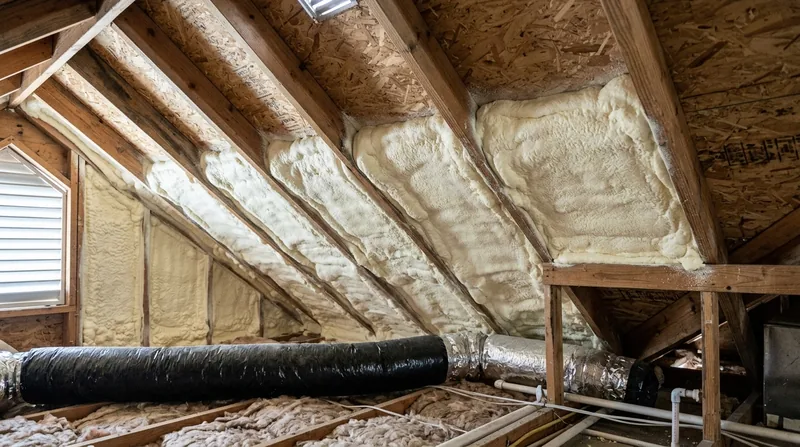




Open Cell Spray Foam Insulation in McKinney is a half-pound foam that air-seals attics and walls at a lower cost per board foot than closed cell, and it arrives with sound dampening between rooms as a built-in benefit. McKinney sits on the Blackland Prairie north of Dallas, where summer heat routinely exceeds 100 degrees and vented attics in the region's brick ranches and two-story homes climb to 140 degrees by mid-afternoon. That thermal load drives cooling bills and pulls conditioned air out through every gap in the framing, rim joist, and ductwork. Open cell foam stops that leakage, cuts the load on the AC system, and costs less than closed cell when the application does not require moisture barrier protection. We work in 1880s Victorians on Chestnut and Church streets, in the 1970s brick ranches off Eldorado Parkway, and in the new two-story subdivisions stretching toward Prosper, Celina, and Anna. On this page, we explain where open cell belongs, how the installation works, what to expect on cost, and how to hire the right contractor for your home.
Why Open Cell Spray Foam Matters in McKinney's Hot, High-Load Attics
McKinney's residential stock runs heavy on vented attics. The older east side and 1970s neighborhoods hold single-story ranches with low-slope attics and original fiberglass batts that have settled, shifted, and left gaps around ductwork, electrical penetrations, and the attic hatch. The newer Stonebridge Ranch, Craig Ranch, and Trinity Falls subdivisions feature two-story homes with vaulted ceilings, bonus rooms, and west-facing walls that bake all afternoon. In both cases, the attic becomes the heat sink. A half-pound open cell foam at 3.5 to 3.7 R-value per inch seals the air leakage path, prevents warm return air from bypassing the insulation, and does the job at a board-foot price that makes it accessible for homeowners who need the thermal break but not the vapor barrier that closed cell provides.
- Open cell foam expands to fill cavities and seal rim joists, band joists, and the attic hatch frame without the cost premium of closed cell.
- The product dampens sound transmission between rooms, a secondary but real benefit in bonus rooms and upstairs bedrooms.
- Because it is not a vapor barrier, it works well in climates where drying to the interior is needed and where the roof deck is vented or where attic ventilation is present.
- A professional spray application ensures consistent thickness, proper drum temperature, and the mechanical ventilation during cure that keeps volatile organic compounds at safe levels.
These advantages make open cell the right choice for most attic retrofits and new attic construction in the McKinney area, especially when the budget does not support a closed cell system.
Key info: McKinney and surrounding areas experience 140-degree attic temperatures in summer and spring hail that tests every roof. Open cell foam seals the thermal envelope and reduces the load on AC systems that work year-round in this climate. A proper installation includes mechanical ventilation during cure and a stated re-entry window of 24 to 48 hours, with low volatile organic compound levels once cured.
For more on the role of air sealing in your home, see our air sealing service page.
How We Install Open Cell Spray Foam in McKinney Homes: The Process
Open cell foam installation begins with a site inspection. We assess the attic structure, identify air leakage paths, check for existing insulation that must be removed or left in place, and verify that the substrate is dry and ready to receive foam. In older McKinney homes with pier-and-beam floors and plank walls, we may recommend foam on the rim joist and band joist to stop cold air infiltration at the foundation line. In newer two-story homes, we spray the attic floor to create a sealed thermal boundary and often foam the sloped roof deck to convert a vented attic into a sealed one. We specify thickness in inches and R-value per the building code and the homeowner's thermal goals, and we provide a written estimate with those specifications before any work begins.
- We protect all HVAC equipment, electrical panels, and fixtures with masking and plastic sheeting before spraying.
- Foam is applied in controlled passes, never exceeding the manufacturer's per-pass thickness limit, to ensure proper curing and avoid off-gassing.
- We maintain mechanical ventilation during and after the spray until the foam has fully cured, typically 24 to 48 hours depending on temperature and humidity.
- After cure, we verify thickness with a depth gauge and provide documentation of the work for your records and for any future contractor or inspector.
The result is a sealed attic with consistent R-value, no thermal bridging at framing, and sound dampening that quiets HVAC noise and weather sounds in the rooms below.
Example: A 1,400-square-foot attic in a Stonebridge Ranch home in McKinney, vented and insulated with settled fiberglass, was retrofitted with 4.5 inches of open cell foam at R-16. The homeowner sealed the attic hatch, sealed the rim joist above the garage, and replaced the attic insulation in one project. Total thickness was 5.5 inches where new foam was applied over the old batts, and the attic hatch was air-sealed with foam and a gasket. The job took two days, with cure time completed before re-entry.
Learn more about attic spray foam insulation and how it compares to other methods.
Methods Comparison Table
| Approach | Description | Best For |
|---|---|---|
| Open Cell Spray Foam | Half-pound foam, 3.5 to 3.7 R-value per inch, expands to fill cavities, includes sound dampening, requires ventilation during cure. | Vented attics, standard construction, air sealing on a budget, interior walls where sound control matters. |
| Closed Cell Spray Foam | Two-pound foam, 6.0 to 7.0 R-value per inch, acts as a vapor barrier, denser and stronger, premium cost per board foot. | Sealed attics, metal buildings, crawl spaces with moisture, rim joists where vapor control is required. |
| Blown-In Fiberglass or Cellulose | Loose-fill insulation, lower R-value per inch, settles over time, no air sealing of gaps. | Top-up of sound attics where air sealing is not the priority and cost is the primary constraint. |
| Injection Foam Into Existing Walls | Closed or open cell foam injected into cavities of finished walls without demolition, retrofit method for pre-1980 construction. | Older McKinney Victorians and ranches with plank walls and no cavity insulation, exterior wall cold spots. |
Open Cell Spray Foam Insulation Cost in McKinney: What to Expect
Open cell spray foam pricing in McKinney starts at approximately $0.55 per board foot and can range up to $0.75 per board foot depending on job complexity, attic access, substrate condition, and the amount of existing insulation that must be removed or worked around. A typical 1,200-square-foot attic retrofit with 4 inches of open cell foam applied over settled fiberglass runs 4,800 to 5,200 board feet and falls in the $2,600 to $3,900 range before any removal work. If old insulation must be pulled out, vacuumed, and disposed of, add $400 to $800 for that labor. Access difficulty, such as a cramped attic with low headroom or complex framing, can push costs higher. Sealed roof decks and rim joist work on multi-story homes also increase the scope and the ticket.
The best way to understand cost for your specific home is to request a free written estimate. We measure the attic or wall cavity on site, specify the R-value and thickness we recommend, detail any removal work required, and quote a firm price with no surprises. We respond within 24 hours and can often schedule work within one to two weeks depending on season and crew availability.
Visit our pricing page for more detail on what moves the cost up or down, and call (469) 247-0288 to book your free estimate.
What to Look for When Hiring a Spray Foam Insulation Contractor Near McKinney
Spray foam insulation is not a licensed trade in Texas at the state level, but contractor registration and permitting requirements vary by city. McKinney, Plano, Frisco, Allen, and other municipalities in Collin County each maintain their own contractor registration and permitting processes. Before hiring any spray foam contractor, including us, ask to see proof of current business registration with your city and confirmation of any required permits for your address. Verify that the contractor carries general liability insurance and that the policy is current. A reputable installer will provide a written estimate with R-value, thickness, and the scope of any removal or air sealing work, and will explain the cure timeline and re-entry window before work begins.
- Request at least two or three estimates so you can compare scope, specifications, and price across contractors.
- Ask each contractor about their mechanical ventilation setup during cure and their re-entry policy, which should be 24 to 48 hours minimum.
- Check references with recent customers in your area, specifically asking about smell, timeline, cleanup, and whether the installer was reachable after the job was complete.
- Confirm that the contractor understands local building code for attic ventilation, thermal barriers, and ignition barriers, and that they defer to your local building official on what applies to your address.
- If your home is in a master-planned community like Stonebridge Ranch or Craig Ranch, ask whether HOA approval is required for any exterior work on metal buildings or garage additions.
The local independent contractor who knows McKinney's building stock, climate, and code environment is your best choice. We have been in business since 2012, we are fully insured, and we provide written estimates with no obligation. Call us at (469) 247-0288 or visit our contact page to schedule your free estimate today.
Open Cell Spray Foam Insulation in McKinney: Pricing Guide
| Service | Price | Details |
|---|---|---|
| Open Cell Spray Foam, Attic Retrofit | Starting at $0.55/board ft | Includes foam application, controlled thickness per pass, mechanical ventilation during cure, and depth verification after cure completion |
| Removal of Old Insulation | Starting at $400 | Labor to vacuum out settled fiberglass or cellulose, haul to recycling facility, and prepare substrate for new foam application |
| Rim Joist and Band Joist Air Sealing | Starting at $600 | Open cell foam applied to foundation rim and band joists on single or multi-story homes, seals cold air infiltration at the perimeter |
| Sealed Roof Deck or Vaulted Ceiling | On estimate | Complex geometry, multiple passes, and structural considerations require on-site assessment before a firm quote is provided |
| Travel and Estimate | Included/Free | No mileage fee in McKinney and surrounding areas, free written estimate with R-value and thickness specs, response within 24 hours |
Indicative pricing, the exact cost depends on square footage, finish, and site access. Free personalized estimate within 24h at (469) 247-0288.


