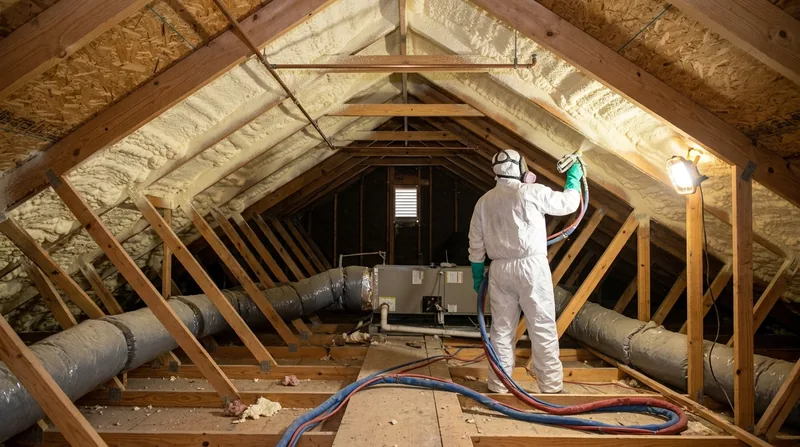




Attic spray foam insulation in McKinney turns a 150-degree furnace into conditioned space. McKinney sits on the Blackland Prairie north of Dallas, where summer attics routinely hit 140 degrees by mid-afternoon, and every house from the 1880s Victorians around the courthouse square to the new two-story brick subdivisions spreading toward Prosper and Celina carries its air handler and ductwork in a vented attic that leaks conditioned air constantly. Open-cell foam on the roof deck seals that envelope, brings ductwork and attic water lines inside the thermal boundary, and delivers the lesson Winter Storm Uri taught: a sealed attic survives what a vented one does not. Every estimate we write lists the R-value, thickness per pass, and board footage so you know exactly what you are paying for.
Why Attic Spray Foam Insulation Matters in McKinney's Hot Climate
McKinney summers demand that your attic work for you, not against you. A standard vented attic with fiberglass batts or blown-in cellulose creates a temperature differential that pulls conditioned air up through ceiling penetrations, around electrical boxes, and through rim joists. Your air conditioning runs nonstop to replace what is escaping, and your utility bill reflects every degree of that waste. Spray foam seals the attic from the inside out, eliminates the stack effect that drives air leakage, and keeps ductwork at indoor temperature so every ton of cooling reaches the rooms where it matters.
- Sealed attics reduce peak cooling load by controlling the temperature around ductwork and air handlers.
- Open-cell foam allows the roof deck to breathe and manage moisture in the humid McKinney climate.
- Closed-cell foam delivers higher R-value in tight spaces and resists the moisture that ice dams and spring rains bring.
- Attic water lines and electrical runs stay protected inside the envelope, not exposed to 140-degree heat.
- A sealed attic qualifies for the federal energy efficiency tax credit when the work meets code requirements.
The difference shows up in comfort and bills within the first billing cycle after installation.
Key info: McKinney sits in Collin County, where the building official enforces the energy and building code in effect at your address. Thermal barriers and ignition barriers for spray foam are governed by code, not by us. We help you navigate what applies to your job and confirm it with the city before work begins. The fifteen-minute thermal barrier distinction is the detail most generalists miss, and naming it correctly is itself the expertise signal.
For more detail on how open-cell and closed-cell foam differ and which fits your attic, see our open-cell spray foam page or our closed-cell spray foam page.
How We Spray Foam Your McKinney Attic: From Estimate to Completion
Every attic is different. Your home might be a 1920s Craftsman bungalow with a low-slope pier-and-beam attic, a 1980s brick ranch with original fill and flat ceiling, or a 2010s two-story with vaulted ceilings and bonus rooms over a three-car garage. We show up with a tape measure, a moisture meter, and a written estimate that lists the R-value, thickness per pass, and board footage so you know the scope before we spray a single board foot. We identify where air is leaking, where moisture is present, and whether the substrate is sound. If it is not, we tell you straight and walk away rather than spray over a wet or contaminated surface.
- We inspect the attic for existing insulation, air leaks, moisture, and structural condition.
- We provide a written estimate with R-value, thickness, and board footage before any work begins.
- We set up mechanical ventilation during the spray and cure process to control VOC off-gassing.
- We spray in controlled passes to achieve the thickness and density required by the manufacturer and the code.
- We install thermal and ignition barriers where code requires them, confirmed with the local building official.
- We seal air leaks around ductwork, electrical penetrations, plumbing vents, and rim joists as part of the spray.
- We provide a re-entry window of 24 to 48 hours before the attic is safe to occupy or enter for storage.
The job is done when the attic is sealed, the foam is cured, and your air handler and ductwork are inside a conditioned envelope.
Example: A 2,000-square-foot two-story in Stonebridge Ranch or Craig Ranch typically carries 1,200 to 1,500 square feet of attic floor space. Sealing it with open-cell foam to R-38 takes one to two days, depending on existing insulation and the complexity of ductwork and penetrations. A sealed attic in Allen or Frisco with a high vaulted ceiling might require closed-cell foam to control moisture, which adds cost but delivers R-7 per inch instead of R-3.5, so the total thickness is thinner and the job is faster.
Learn more about our air sealing work and how it complements spray foam insulation.
Attic Spray Foam Insulation Methods: Open-Cell vs. Closed-Cell
| Method | Description | Best For |
|---|---|---|
| Open-Cell Spray Foam | Lower density, R-3.5 per inch, softer texture, allows vapor transmission, low-VOC once cured. | Attics with stable roof decks, sound substrates, and no standing moisture. Standard choice for McKinney vented-attic conversions. |
| Closed-Cell Spray Foam | Higher density, R-7 per inch, rigid, vapor barrier, resists moisture penetration and condensation. | Metal buildings, pole barns, rim joists, areas exposed to standing water or high humidity, and attics where thickness must be minimal. |
| Hybrid or Top-Up | Spray foam added over existing sound insulation to reach target R-value without full removal. | Attics with settled or compressed batts that still have structural value. Saves cost and time when the base layer is good. |
| Insulation Removal + Spray Foam | Full removal of failed, contaminated, or settled insulation, substrate cleaning, new spray foam installation. | Attics with mold, rodent nesting, wet batts, or fiberglass that has lost 50% or more of its R-value. |
Attic Spray Foam Insulation Cost in McKinney: What to Expect
Attic spray foam insulation in McKinney starts at roughly $1.50 per square foot for open-cell foam on a straightforward attic with good access and sound substrate. That figure moves up or down based on the actual conditions on your roof: existing insulation that must be removed, moisture or contamination that requires substrate prep, tight access that slows the crew, and the R-value you are targeting. A 1,200-square-foot attic in a new subdivision in Stonebridge Ranch or Craig Ranch with no existing insulation and clean substrate might land in the $1,800 to $2,400 range for open-cell to R-38. An older home in east McKinney or Frisco with settled batts, tight access, and moisture concerns will cost more because the work is more complex. Closed-cell foam, which delivers R-7 per inch instead of R-3.5, costs more per board foot but uses less material to reach the same R-value, so the total can be competitive on smaller spaces like rim joists or bonus rooms.
The only honest way to know your cost is to get a free written estimate from us. We show up, measure the space, look at the substrate and existing conditions, and give you a number with R-value and thickness spelled out. We do not guess, we do not quote a price per board foot over the phone, and we do not surprise you after the work starts. If you want to see typical pricing across different job types and sizes, our full pricing page breaks down the factors that move the needle.
Why get multiple estimates: Spray foam is not a commodity. Two contractors can look at the same attic and propose different thicknesses, different R-values, and vastly different prices. A low estimate without R-value and thickness specs is a red flag. A crew that promises immediate re-entry and no mechanical ventilation is cutting corners. Get at least two written estimates, compare the R-value and thickness, ask about the thermal barrier requirement, confirm insurance and what happens if something goes wrong, and then call us at (469) 247-0288 if you have questions about what you are reading.
Attic Spray Foam Insulation Near Me: What McKinney Homeowners Should Know When Hiring a Contractor
Spray foam insulation is not a licensed trade at the state level in Texas, but the city where you live may require contractor registration before any work begins. McKinney, Plano, Frisco, Allen, and other municipalities in Greater McKinney each set their own rules, and there is no reciprocity between them. Before you hire any contractor, including us, ask to see the registration or license your city requires and confirm it with the city building or planning department. Texas regulates air conditioning and plumbing as licensed trades, so if your HVAC system needs duct work or a new air handler, that work belongs to a licensed air conditioning contractor, not to an insulation crew. We handle insulation and air sealing only.
- Verify that any contractor carries liability and workers compensation insurance and ask to see the certificate.
- Request a written estimate with R-value, thickness per pass, and board footage so you know what you are paying for.
- Ask about the thermal barrier and ignition barrier requirements for your city and confirm they will be installed per code.
- Check references from jobs in your neighborhood, not just a list of names, and call those homeowners to ask about the work and the experience.
- Confirm the re-entry window and what mechanical ventilation will be in place during spray and cure.
- Understand what happens if the work does not meet code or if something goes wrong after completion, and get that in writing.
The strongest sign of a professional is someone who walks away from a bad job. If your attic has standing water, active leaks, or mold, we fix the moisture first or we walk away. We do not spray over wet substrate, and we do not promise to remediate mold or handle rodent decontamination because those are separately regulated trades. We do the insulation and air sealing part, and we do it right.
Call us at (469) 247-0288 or request a free estimate. We will be honest about what your attic needs and what it will cost.
Attic Spray Foam Insulation in McKinney: Pricing Guide
| Service | Price | Details |
|---|---|---|
| Open-Cell Spray Foam Attic | Starting at $1.50/sq ft | Standard choice for McKinney vented attics converted to sealed space, includes mechanical ventilation during cure and thermal barrier installation per code |
| Closed-Cell Spray Foam Attic | Starting at $2.25/sq ft | Higher R-value per inch for tight spaces or moisture control, cost varies with thickness and existing conditions that require substrate prep |
| Insulation Removal and Replacement | On estimate | Full tearout of failed or contaminated insulation, substrate cleaning, and new spray foam installation requires on-site inspection to determine scope and complexity |
| Travel | Included | No separate call-out fee or mileage charge for service areas in McKinney, Plano, Frisco, Allen, Prosper, Celina, Anna, Melissa and surrounding communities |
| Free Written Estimate | No charge | Response within 24 hours at (469) 247-0288, includes R-value, thickness, and board footage, no obligation to book after we measure and inspect |
Indicative pricing, the exact cost depends on square footage, finish, and site access. Free personalized estimate within 24h at (469) 247-0288.


