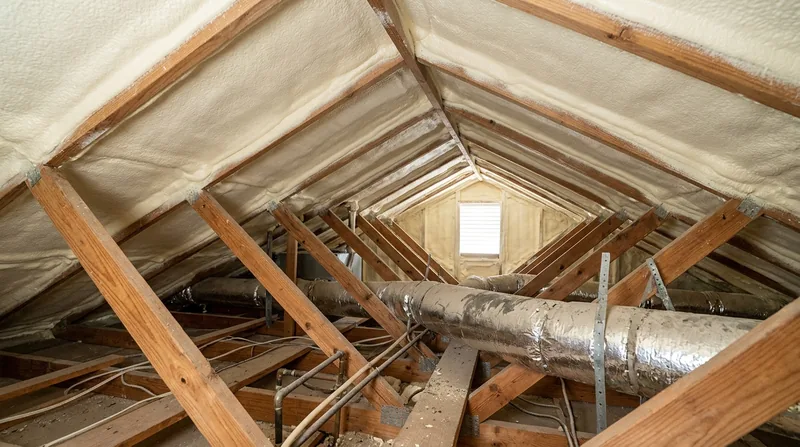




Closed cell spray foam insulation in McKinney delivers R-6.5 per inch with its own vapor retarder and genuine structural stiffening. McKinney sits on the Blackland Prairie north of Dallas, where summer heat climbs past 100 degrees for weeks and the clay soil beneath slab-on-grade homes swells and shrinks with every freeze and thaw. The older Victorians and Craftsman bungalows downtown, the 1970s-90s brick ranches, and the newer two-story homes spreading toward Prosper and Celina all face the same problem: attics that hit 140 degrees by mid-afternoon, metal buildings and barndominiums that sweat condensation on cold mornings, and pier-and-beam subfloors that need both vapor control and real insulation value. Closed cell foam is the product built for exactly this job. We have been installing spray foam insulation since 2012 across McKinney and the surrounding Collin County area, and we deliver written estimates with R-value and thickness specs before we spray a single board foot.
Why Closed Cell Spray Foam Matters in McKinney's Heat and Humidity
McKinney's climate and building stock create a perfect storm for insulation failure. Vented attics in older homes pull hot, humid air in from the outside, and that air condenses on cool surfaces when the sun sets or when the AC runs hard. Metal buildings and pole barns on acreage corrode from the inside out because moisture gets trapped between the steel and the insulation. Pier-and-beam subfloors under 1920s Victorians and 1970s ranches are exposed to ground moisture and outdoor temperature swings. Closed cell foam stops all three failure modes at once because it acts as its own vapor retarder, it stiffens the structure it coats, and it fills every cavity and crack in a single pass.
- Closed cell foam blocks moisture from entering the cavity while allowing the structure to dry to the inside if water somehow gets past the foam.
- The material carries an R-value of 6.5 per inch, so a 5.5-inch application delivers R-36 in a space where fiberglass would need 11 inches to reach the same rating.
- It adds structural stiffness to metal building walls and roof decks, reducing panel flutter and lowering cooling costs in summer.
- It seals every penetration, rim joist, and band board in one application, eliminating the piecemeal air sealing that blown-in insulation leaves behind.
These are not abstract benefits. They are the difference between an attic that stays dry and one that breeds mold, between a metal building that holds its shape and one that drums in the wind, and between a crawl space that stays stable and one that heaves and cracks the slab above it.
Key info: McKinney and Collin County sit on black expansive clay that swells when wet and shrinks when dry. Closed cell foam on pier-and-beam subfloors and rim joists reduces moisture infiltration that drives that clay movement, which helps prevent foundation cracks and slab heave in the homes built over it.
For more on how this works in vented and sealed attics, see our attic spray foam insulation page.
How We Install Closed Cell Spray Foam in McKinney Homes and Buildings
Closed cell spray foam is applied as a liquid that expands and hardens in place. The process is quick, but it requires precision: the equipment must maintain the correct drum temperature and chemical ratio, the operator must spray at the right thickness per pass (typically 1.5 to 2 inches), and the space must be mechanically ventilated during cure and for a full 24 to 48 hours afterward. We do not cut corners on any of these steps because poor installation is the source of every bad spray foam story you have heard.
- We visit your home or building, inspect the substrate for moisture and damage, and measure the cavities or surfaces to be insulated.
- We provide a written estimate that specifies the R-value, the foam thickness in inches, and the total board footage we will apply.
- On the day of installation, we set up mechanical ventilation and seal off the work area to contain overspray.
- We spray the foam in thin, controlled passes, allowing each pass to cure before we apply the next, building to the specified thickness.
- We leave mechanical ventilation running for the full cure window and provide written re-entry guidance before we leave the site.
In a 1,200-square-foot vented attic in McKinney, a closed cell application typically takes one to two days from setup through final cure. In a metal building, the job size scales with the wall and roof area, but the process is identical: controlled passes, proper ventilation, and no shortcuts.
Example: A Stonebridge Ranch home with a vaulted attic over a bonus room got 5.5 inches of closed cell foam in the sealed roof cavity, reaching R-36. A pole barn on acreage near Celina got 4 inches on the interior of the metal walls and 5.5 inches on the underside of the roof deck. Both jobs required removal of the old fiberglass first. See our insulation removal page for details.
| Approach | Description | Best for |
|---|---|---|
| Sealed attic with closed cell | 5 to 6 inches of 2-pound foam applied to the underside of the roof deck, creating an unvented, conditioned attic space. | Vaulted ceilings, bonus rooms, HVAC equipment in the attic, homes where attic ventilation is blocked or where summer temperatures spike. |
| Metal building wall and roof insulation | 4 to 5.5 inches on interior walls and roof decks, sealing the entire cavity and preventing condensation on the steel. | Pole barns, RV garages, horse barns, workshop buildings, and barndominiums where moisture control and thermal performance are critical. |
| Pier-and-beam subfloor and rim joist | 2 to 3 inches on the underside of floor joists and around band joists, creating a vapor barrier and reducing ground moisture infiltration. | 1920s-1970s homes with open crawl spaces, homes on expansive clay, and any structure where floor insulation and moisture control go hand in hand. |
| Wall retrofit with closed cell injection foam | Closed cell foam injected into the cavities of existing exterior walls without demolition, filling every gap and sealing air leaks. | Pre-1980 brick homes, older Victorians and Craftsmans, any structure where opening the walls is not an option but R-value and air sealing are. |
Closed Cell Spray Foam Insulation Cost in McKinney: What to Expect
Closed cell spray foam pricing starts at approximately $1.20 per board foot, but the final cost depends on several concrete factors. The thickness required (measured in inches and driven by your R-value target) is the biggest variable. Access to the application area matters significantly: an open attic is faster and cheaper than a tight crawl space or a metal building with high walls. Whether you need old insulation removed first adds labor and disposal cost. The substrate condition also affects the price: a dry attic is straightforward, but a wet or contaminated subfloor requires remediation or we walk away. Travel within McKinney and the surrounding Collin County area is included in our estimate, with no separate mileage fee.
A typical sealed attic job in McKinney runs between $3,500 and $7,500 for a 1,200 to 1,500-square-foot space, depending on roof pitch, the extent of air sealing needed, and whether removal is included. A metal building or pole barn scales with the wall and roof area; a 40-by-60-foot shop might run $6,000 to $12,000. Pier-and-beam subfloor work on a 1,500-square-foot footprint typically falls in the $2,000 to $4,500 range. These are ballpark figures. The only way to know what your job will cost is to request a free written estimate, which includes the R-value, thickness, and board footage we will apply.
Get estimates from at least two contractors before you book. A low estimate with no R-value and no thickness spec is a red flag. Choose a contractor who puts the R-value, thickness and re-entry window in writing. We provide estimates within 24 hours at (469) 247-0288, and our estimates are binding on price and scope. For detailed pricing on different project types, see our full pricing page.
What to Look for When Hiring a Closed Cell Spray Foam Insulation Contractor Near McKinney
The spray foam market in McKinney and across Collin County includes local shops, regional outfits, and national franchise rigs that show up, spray, and disappear. The difference between a good installation and a bad one is not visible from the outside, which is why the contractor's process and transparency matter more than the company name. Ask any contractor you call for proof of current insurance, a written estimate with R-value and thickness, and references from jobs done in the last two years. Call those references and ask about the cure window they were given and whether they experienced any odor or re-entry issues. Ask the contractor how they handle permits in your specific city, because McKinney, Plano, Frisco, Allen, and the smaller towns in Collin County each run their own permitting departments, and there is no reciprocity between them.
- Request a written estimate that specifies the R-value per inch, the total thickness in inches, and the square footage or board footage being applied.
- Ask whether the contractor removes old insulation or works over it, and whether that is included in the price or billed separately.
- Confirm that mechanical ventilation will run during the cure window and that you will receive written re-entry guidance before the crew leaves.
- Verify that the contractor is fully insured and ask to see a current certificate of insurance naming your address as additional insured.
- Ask how the contractor handles moisture or contamination on the substrate: if they say they will spray anyway, hire someone else.
- Get at least two estimates and compare them on scope, not price alone.
Contact us for a free estimate and references from McKinney, Plano, Frisco, Allen, Prosper, and surrounding areas. Call (469) 247-0288 or request an estimate online. We have been in business since 2012, we are fully insured, and we provide written estimates with R-value and thickness specs before we spray a single board foot.
Closed Cell Spray Foam Insulation in McKinney: Pricing Guide
| Service | Price | Details |
|---|---|---|
| Sealed attic with closed cell foam | Starting at $1.20/board ft | Includes roof deck application, air sealing, and ventilation during cure; scaling depends on attic size and roof pitch complexity |
| Metal building or pole barn wall and roof insulation | Starting at $1.20/board ft | Includes interior wall and roof deck coverage, condensation control on steel, and full mechanical ventilation; larger buildings require on-site measurement |
| Pier-and-beam subfloor and rim joist insulation | Starting at $1.20/board ft | Includes underside floor joist coverage, band joist sealing, and vapor barrier installation; pricing scales with crawl space size and access difficulty |
| Wall injection foam retrofit (existing walls without demolition) | Starting at $1.20/board ft | Includes cavity drilling, foam injection, and hole patching; pre-1980 brick and older homes require inspection for wall cavity condition |
| Insulation removal and closed cell replacement | On estimate | Removal labor, disposal, and new closed cell application; substrate inspection required to confirm no moisture, contamination, or structural damage before spraying |
| Free written estimate with R-value and thickness specs | Free | Response within 24 hours at (469) 247-0288; no obligation to book, includes travel throughout McKinney and Collin County service area |
Indicative pricing, the exact cost depends on square footage, finish, and site access. Free personalized estimate within 24h at (469) 247-0288.


