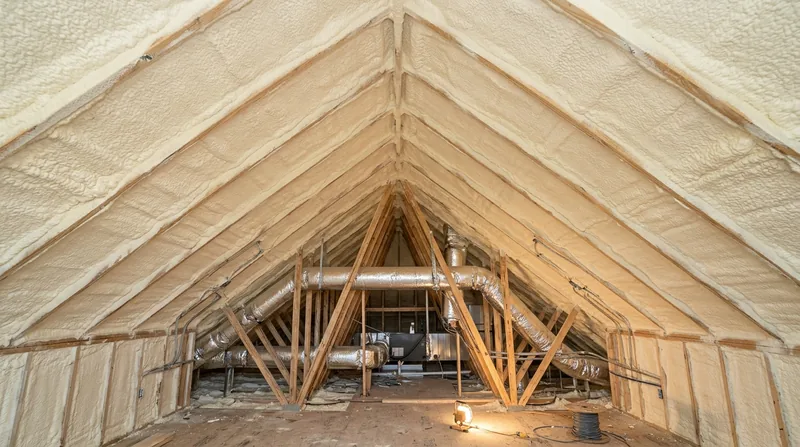




Commercial and new construction spray foam insulation in McKinney serves warehouses, office parks, production facilities and spec homes along the US 75 corridor and across the Collin County industrial belt. The Blackland Prairie climate here runs brutal summers past 100 degrees for weeks, winter ice storms that test every roof assembly, and spring hail that drives builders and property managers to demand code-compliant thermal and air barriers that inspectors will actually sign off on. New construction on the east side toward Farmersville and along the Celina and Prosper expansion zones means metal buildings, pole barns and steel-frame commercial shells that sweat condensation on cold mornings without closed-cell foam and proper air sealing. Phased work on occupied warehouses and offices requires scheduling that keeps your operation running while we spray. Documentation that your building official will accept, not a generic warranty card, is what separates a professional installation from a rig-and-run job that leaves you holding the phone when the smell will not clear or the foam cures soft.
Why Commercial and New Construction Spray Foam Matters in McKinney Industrial Parks and New Subdivisions
The industrial corridor from McKinney north to Sherman runs metal warehouses, manufacturing plants and logistics facilities that depend on thermal control and moisture management. New construction in Stonebridge Ranch, Craig Ranch, Trinity Falls and the subdivisions spreading toward Celina and Anna means two-story homes with vaulted ceilings, bonus rooms and west-facing walls that bake all afternoon without a proper sealed attic or rim-joist barrier. Spray foam on new construction is installed before drywall and trim close the walls, which means no demolition, no disruption to tenants, and code compliance documented at framing inspection. Retrofit work on occupied commercial space requires scheduling around business hours and phased application so your crew does not interfere with production or customer traffic.
- Metal building envelopes require closed-cell foam to control condensation and prevent rust on steel framing in the hot, humid summers and cold winter mornings of North Texas.
- New construction assembly drawings and energy code compliance demand written specifications with R-value, thickness and thermal barrier documentation that your building official will accept at framing inspection.
- Phased work on warehouses and offices keeps your operation running while we spray sealed attics, rim joists, band joists and wall cavities on schedule.
- Air sealing around penetrations, ductwork chases and band board details is the difference between a code-compliant assembly and one that leaks conditioned air into unconditioned space.
Proper installation on new construction means no call-backs, no warranty disputes and a building that performs as designed from day one.
Key info: A 50,000-square-foot warehouse on the US 75 corridor near McKinney that uses closed-cell foam on the roof deck and rim joist will control interior condensation and maintain consistent thermal performance through the 100-degree summers and occasional winter ice storms that test every building envelope in Collin County.
See our closed-cell spray foam insulation page for technical details and R-value specifications.
How We Install Commercial and New Construction Spray Foam in McKinney: Step-by-Step Process
Commercial and new construction projects follow a documented process from site survey through final inspection. We measure the space, identify all air leakage paths, specify foam type and thickness per the energy code and assembly drawings, and schedule work around your construction timeline or business operations. Mechanical ventilation runs during cure to manage off-gassing, and we document everything your building official needs to see at framing and final inspection. A typical new construction attic or rim joist spray is complete in a single day, while larger warehouses or phased commercial work may span multiple visits on your schedule.
- We survey the space, identify the substrate condition and all air leakage paths that need sealing.
- We specify foam type (closed-cell or open-cell), thickness and R-value based on code requirements and your building design.
- We prepare the space, protect areas outside the spray zone and set up mechanical ventilation for cure.
- We spray foam at the correct drum temperature and ratio, with controlled thickness per pass as the manufacturer requires.
- We air seal all penetrations, rim details and mechanical chases with foam or compatible sealant.
- We document thickness, R-value and thermal barrier compliance for your building official and provide a written estimate with specifications before any work begins.
On-site documentation and code-compliant assembly details mean your inspection passes the first time.
Example: A new office building in Frisco with a vaulted ceiling and open floor plan required closed-cell foam on the roof deck and open-cell foam in the walls to meet energy code and control sound transmission. We sprayed the roof deck at framing stage, sealed all rim and band joist details, and provided the building official with written specifications showing R-value and thermal barrier thickness. Final inspection passed without call-backs.
Learn more about our air sealing and thermal barrier work for complete assembly compliance.
Commercial and New Construction Spray Foam Methods and Applications
| Approach | Description | Best For |
|---|---|---|
| Closed-Cell Foam on Metal Buildings | High-density foam that stops moisture and air leakage on steel framing and roof decks. Adds structural rigidity and controls condensation in hot, humid climates. | Warehouses, logistics facilities, steel shops and pole barns on the US 75 corridor and industrial areas near Sherman and Denison. |
| Open-Cell Foam in New Construction Walls | Low-density foam that fills cavities and dampens sound transmission. Flexible and cost-effective for interior wall insulation before drywall. | New office buildings, production facilities and spec homes with vaulted ceilings and bonus rooms that require both thermal control and acoustic performance. |
| Sealed Attic Assemblies on New Construction | Closed-cell or open-cell foam sprayed on the roof deck to create a conditioned attic space. Eliminates hot-attic penalty and simplifies HVAC ductwork routing. | Two-story homes in Stonebridge Ranch, Craig Ranch and Trinity Falls with west-facing roofs that experience 140-degree attic temperatures in summer. |
| Rim and Band Joist Sealing | Closed-cell foam applied to the rim joist and band board to stop air leakage and thermal loss at the foundation perimeter. Critical for new construction energy code compliance. | All new construction in McKinney, Plano, Allen and surrounding areas where Blackland Prairie clay and slab-on-grade foundations require continuous thermal and air barriers. |
Commercial and New Construction Spray Foam Cost in McKinney: What to Expect
Commercial and new construction spray foam pricing depends on the square footage of the space, foam type (closed-cell or open-cell), assembly complexity and whether the work is done at framing stage or as a retrofit on an occupied building. A free commercial estimate is the starting point, and we measure the space on site to provide a written specification with R-value, thickness and total board-foot requirement. Closed-cell foam costs more per board foot than open-cell but offers superior moisture control and structural performance on metal buildings and sealed attics. New construction work done at framing stage is faster and less expensive than retrofit work on occupied facilities because there is no need to work around tenant operations or existing construction.
Factors that affect cost include the size of the space, the complexity of the assembly (roof deck, walls, rim joists, mechanical chases), accessibility for equipment and crew, substrate condition and whether mechanical ventilation and temporary containment are required during cure. A 2,000-square-foot warehouse rim joist and roof deck sealed with closed-cell foam may run from $3,000 to $6,000 depending on thickness and detail work. A new construction attic spray on a 3,000-square-foot home with a sealed roof deck and rim joist details typically runs $2,500 to $5,000. Always get a written estimate with specifications before committing, and compare 2 to 3 contractors to understand the market rate in your area.
See our full pricing overview for typical ranges and the factors that move cost up or down.
What to Look for When Hiring a Commercial and New Construction Spray Foam Contractor Near McKinney
Hiring a spray foam contractor for commercial or new construction work requires checking references, understanding permit and code compliance requirements for your city, and verifying that the contractor carries full insurance and can provide written estimates with R-value and thickness specifications. Texas regulates contractors at the municipal level, not the state level, so contractor registration and bonding rules vary from city to city. The City of McKinney, Plano, Frisco, Allen and other municipalities in the service area each maintain their own contractor registration requirements, and you should confirm with your city building department what credentials any contractor must hold before work begins. A reputable spray foam contractor will have references from recent commercial or new construction projects, will provide a written estimate with detailed specifications, and will explain the cure timeline and re-entry window (typically 24 to 48 hours) before work starts.
- Ask any contractor for proof of full insurance coverage and a certificate of insurance naming your project or address.
- Request references from at least two recent commercial or new construction projects in McKinney or a nearby city.
- Verify that the contractor can provide a written estimate with R-value, thickness in inches and total board-foot specification.
- Confirm with your city building department whether the contractor holds the contractor registration your city requires before any work begins.
- Ask about mechanical ventilation during cure, the re-entry timeline and whether the contractor will provide documentation for your building official.
- Get a detailed scope of work that lists all areas to be sprayed, foam type, and any air sealing or thermal barrier work included.
A professional contractor will answer all these questions clearly and will not rush you into a contract without a site survey and written specification.
Call us at (469) 247-0288 or request a free commercial estimate to discuss your project and get a written specification with no obligation to book.
Commercial & New Construction Spray Foam in McKinney: Pricing Guide
| Service | Price | Details |
|---|---|---|
| Free Commercial Estimate | Free | On-site survey, written specification with R-value and thickness, response within 24 hours, no obligation |
| Rim Joist and Band Joist Sealing | Starting at $1,200 | Closed-cell foam on foundation perimeter, includes air sealing and thermal barrier documentation for code compliance |
| Metal Building or Warehouse Roof Deck and Rim | Starting at $3,000 | Closed-cell foam on steel framing, includes condensation control and structural performance, square footage and access determine final price |
| New Construction Sealed Attic or Vaulted Ceiling | Starting at $2,500 | Closed-cell or open-cell foam on roof deck, rim joists and mechanical chases, includes building official documentation and thermal barrier compliance |
| Large-Scale or Phased Commercial Work | On Estimate | Warehouses, office parks and multi-phase projects require site survey and scheduling to provide accurate specification and timeline |
| Travel and Setup | Included | No separate mileage fee or travel charge in McKinney and surrounding service areas |
Indicative pricing, the exact cost depends on square footage, finish, and site access. Free personalized estimate within 24h at (469) 247-0288.


